What Does Adoption Mean in the Bible? The Gospel Truth Most Christians Assume but Never Understand
By Kristen Lam, Woo Kae Sheng
Here is a strange fact about the doctrine of adoption: it is everywhere in the New Testament, and almost nowhere in the average Christian's vocabulary. We talk easily about being forgiven, saved, and born again, but ask the person in the next pew what it means to be adopted by God and you will often get a pause rather than a confident answer.
That pause, that struggle to pinpoint what exactly the Bible says about God's adoption of His people, matters more than it may appear. Though often overlooked, the doctrine of adoption is more than just a footnote to the gospel. According to the New Testament, it is one of the warmest doctrines that every Christian needs in order to rightly understand their relationship with their heavenly Father.
The word behind the doctrine
The Greek word the Apostle Paul uses is huiothesia, which translates literally as "placing as a son." In the Greco-Roman world this was a precise legal act, not a sentimental one. An adopted child did not become a half-member of the family or merely reside as a long-term guest. He received a new name, a new father, and with them the full rights as an heir. His old debts and penalties were cancelled and his former identity was legally erased.
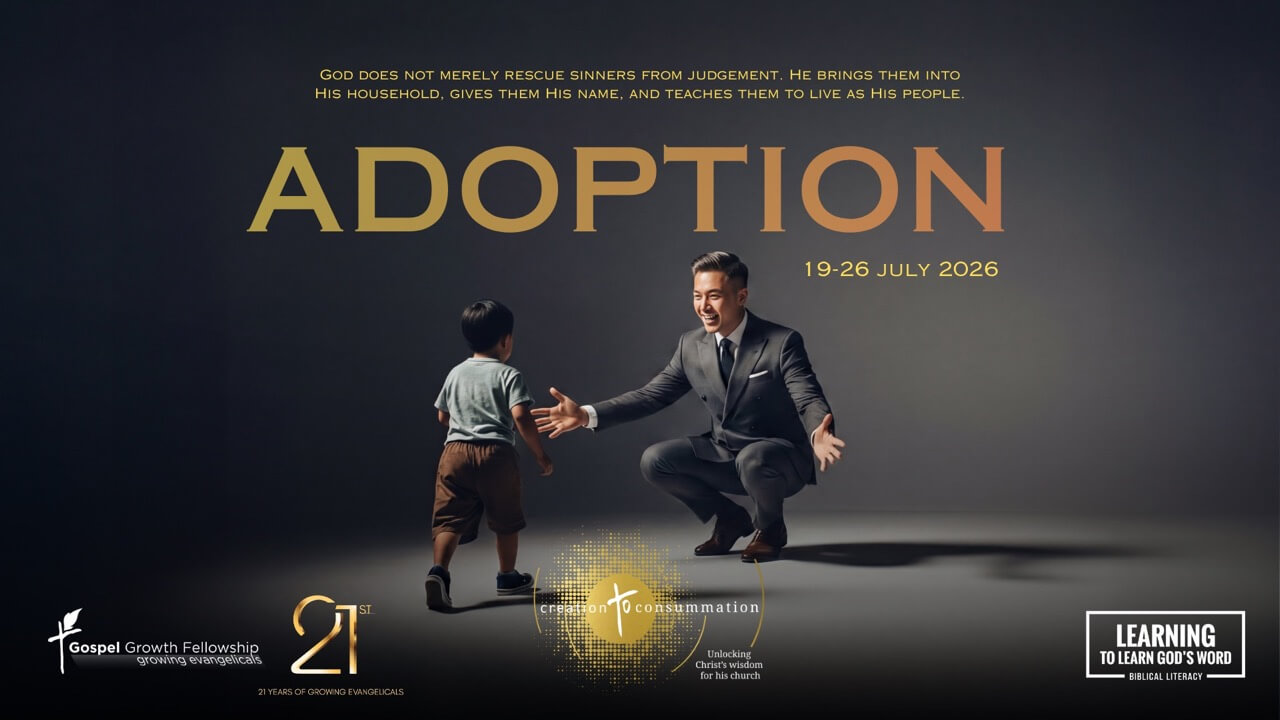
Paul reaches for exactly that picture to describe what God does for those who trust Christ. "You received the Spirit of adoption as sons, by whom we cry, 'Abba! Father!'" (Romans 8:15). This is the Bible's claim: God does not merely acquit guilty sinners and leave them to their own devices. He brings them into His household, gives them His name, calls them family, and makes them heirs alongside His own Son.
Adoption is not the same as justification
Adoption and justification are inseparable, and they share much common ground throughout the narrative of the gospel. Yet they are not the same thing, and this distinction tends to surprise most people.
Consider this: a judge declares a defendant innocent, justice is satisfied, the record is clean. That is what the gospel sounds like to many of us when adoption goes unexamined. The gospel is reduced to a transaction, a means by which the Christian is justified and forgiven, but emptied of the deep relational dimension with God that ought to shape the whole of Christian life.
Now consider this: the same judge steps down from the bench, walks across the courtroom, and says, "Come home with me. You are my child now." That act is what the Bible means by God's adoption of His people. Justification settles our legal standing before God; adoption settles our family relationship with God, welcoming us into His household forever. One may be pardoned by a stranger and still walk away as a stranger; one cannot be adopted by a stranger and remain one.
The New Testament insists that believers receive both simultaneously yet refuses to allow us to collapse them into a single thing. As the older theologians expressed it, justification gives us a clear standing before God; adoption gives us a Father.
Why this changes everything
When adoption is assumed but never truly understood, the symptoms appear quietly. Christian assurance weakens, because we continue relating to God as a judge we hope to satisfy rather than a Father who has already claimed us. Prayer becomes distant and formal. Obedience curdles into anxious performance. And the life of the church grows thin, because we forget that those beside us are not merely fellow attendees but actual siblings, a family gathered from every tribe and tongue.
When adoption is grasped through the Bible's storyline, however, the whole of the Christian life steadies. We cease striving to earn a place at a table that is already ours. We pray differently. We suffer differently, because an heir endures hardship knowing the triumphant, secured future promised by his heavenly Father and his elder brother, Jesus Christ (Hebrews 2:11). This is why the doctrine has been called "the highest privilege the gospel offers." The theologian J.I. Packer goes so far as to suggest that adoption may rank even above justification, for it tells us not only what God has done for us, but who we now are to Him.
A truth that runs from Genesis to Revelation
Adoption, then, is not a New Testament invention. It runs the full length of Scripture. In the Old Testament, God takes Israel as His son: "Out of Egypt I called my son" (Hosea 11:1). He draws an undeserving people near through His faithful, elective, and covenantal love. The story presses forward through Israel's ongoing faithlessness, bearing the weight of promises yet to be fulfilled. In Christ, the true and obedient Son, adoption at last shines with full clarity, and the church becomes the new-covenant family of God.
Reading the Bible in this way, as one unfolding story from creation to consummation rather than a collection of disconnected passages, is precisely what brings a doctrine like adoption to life. It ceases to be an abstract category and becomes instead the heartbeat of how a Christian understands their place before their Father. And it is in this way that, page by page, line by line, we begin to unlock Christ's wisdom for His church as we come to know Him personally through His Word.
Go deeper at CTC 2026
This is the theme of the Creation to Consummation (CTC) conference 2026: Adoption, held 19–26 July 2026 in Klang Valley (Petaling Jaya), Malaysia. Over the course of the week, New Testament scholar Dr. Trevor J. Burke, author of Adopted into God's Family, will trace the doctrine of adoption through the whole of Scripture and show why it matters profoundly for assurance, holiness, and the health of the Malaysian local church today.
If you have ever sensed that there is more warmth in the gospel than you have yet experienced, the doctrine of adoption is precisely where to look.
Learn more about CTC 2026: Adoption →
Works referenced
- Packer, J. I. (1973). Knowing God. InterVarsity Press.
- Burke, T. J. (2006). Adopted into God's Family: Exploring a Pauline Metaphor (D. A. Carson, Ed.). New Studies in Biblical Theology (Vol. 22). InterVarsity Press.